
Welcome back to Part III of our apologetics series. In this teaching, we will focus on creation.
How did everything begin? It is one of the biggest questions a person can ask, and something everyone struggles with at some point. We belong to a universe that had a beginning, and it is worth knowing how that beginning happened, as it's answer can shape our entire identity.
This is the first session of our walk through Bible history, a course built to take an ordinary reader from Adam to Jesus and to leave you able to open the Old Testament and understand it for yourself. Before we can trace that history, though, we have to settle one thing. Can we actually trust the book that records it? That is what this session is for. It is about the authority of Genesis.
One verse holds the whole course together. Jesus said it, and He said it plainly:
"The scripture cannot be broken." (John 10:35)
If Scripture cannot be broken, then it cannot be untrue, and that has to hold all the way back to the very first page. We are going to test that claim where it can be tested, starting at creation, because Jesus Himself tied the two together:
"If I have told you earthly things and you do not believe, how will you believe if I tell you heavenly things?" (John 3:12)
Creation is an earthly thing. It is the kind of claim that leaves its marks in the rocks and the stars and the record of human history, the kind of thing we can examine. If we will not trust the Bible where we are able to check it, why would we ever trust it about Heaven, which we cannot yet see? So we begin on the ground, with the things that can be weighed and measured, and we lay the groundwork in Genesis.
Why the first page matters so much
If you cannot believe Genesis, how can you believe that Jesus can save you? The whole rescue rests on the diagnosis, and the diagnosis is in the opening chapters. Take those away, and the gospel has nothing to stand on. This is exactly why the beginning of the Bible is the part the world fights hardest.
Think about what a person actually has to attack. You do not have to knock down marriage, and morality, and meaning, and judgment one at a time. You only have to pull out the single foundation they all rest on, which is the Word of God. Knock that out and the rest comes down on its own.
"If the foundations be destroyed, what can the righteous do?" (Psalm 11:3)
When a society spends a few generations teaching its children that they came from nothing, cavemen, or monkeys, we should not be surprised that it has no answer for its own brokenness.
Two Worldviews
There are really only two answers to where everything came from, and they rest on two different sources.
The first is God's Word. "In the beginning God created the heavens and the earth." From this came real morals, the meaning of marriage, a purpose to your life, and a reason to prepare for eternity. We are made by God, on purpose, and we are here to be reconciled to the One who made us.
The second is man's opinion. Today it takes the shape of the Big Bang and evolution. No God. And if there is no God, there is no fixed right and wrong, no purpose woven into your life, and nothing to do but live for today. If it feels good, do it, because there are no consequences and nothing after death is guaranteed. Two starting points, and they grow into two completely different lives.
The problems with the Big Bang
Let's start with man's best theory for the origin of the universe. The claim is that somewhere between thirteen and fifteen billion years ago a tiny concentration of matter exploded, and everything we see came out of it.
The trouble is that an explosion has never been observed to build anything. Imagine telling a builder to pile up bricks and timber and nails, push a few sticks of dynamite into it, light it, and come back to a finished house. We would laugh. And yet, that is what we are told happened by wordly scientists.
There are at least five scientific problems with it that no secular scientist has answered. Here are the main ones.
- The missing origin. The theory assumes a starting concentration of energy or matter. Where did that come from? Something does not come from nothing. There is no answer.
- The missing fuse. A mass that dense would be held together by its own gravity, locked in a single black hole. Gravity would keep it from ever expanding. So what lit the fuse and set it off? There is no answer.
- The missing star formation. Explosions produce an outward spray of gas and radiation. They do not gather themselves back into ordered planets and stars and galaxies. They scatter; they do not build.
- The missing life. If chance can produce life as easily as the theory needs, then life should have appeared everywhere, and space should be crowded with signals from other intelligent beings trying to reach us. Instead, we look out into a vast silence and have to ask, where is everybody?
Start with the Bible and let it inform how you see everything. Start by denying it, and you are left holding a row of mysteries with no way to solve them. The honest summary is that the Big Bang answers nothing. It simply says that everything was made out of nothing. The alternative is that everything was made by Someone, and that Someone is very intelligent.
The Problem with Evolution
Evolution builds on the Big Bang Theory. It states that microbes slowly became man. Someone once summed it up as going from the goo to the zoo to you. We at Love Church believe in adaptation, NOT evolution, because we do see adaptation. We do see natural selection. Everyone agrees with that. What no one has ever seen is one kind of creature turning into another kind, with genuinely new information added. This has never been observed in history.
Because that change is never actually observed, the theory has to lean on one phrase, repeated everywhere you hear the subject discussed: billions or millions of years.

This is done for one reason - it is too far to truly prove or disprove. It is strange. The same mind that says it cannot trust the New Testament, with its twenty-four thousand surviving Greek manuscripts and barely two thousand years between us and the events, will turn around and call something that happened twenty million years ago, which no one saw, and no one wrote down, perfectly believable.
That is not where the evidence leads. That is where a person ends up when they have decided in advance to leave God out, and then go looking for any story that will let them.
What the Bible actually says
Now let's move to the Bible's account. The Bible says that God created in six days and rested on the seventh, and by counting the genealogies forward from Genesis 1:1 we land at roughly six thousand years. That's it. No special stories, no millions and billions. Just pure maths. 6000 years!
People stumble over the timescale, but the question is not really "why so short." If anything, God could have spoken it all into being in an instant. He took six days, and I think He did it in part to help us, to set the rhythm of our own week.
The seven-day week
We can explain almost every unit of time we keep. A day is one turn of the Earth on its axis. A month roughly follows the moon around the Earth. A year is one trip of the Earth around the Sun. Every one of those has a reason written in the sky. But the seven-day week has no astronomical basis at all. Nothing in the heavens runs on a seven-day cycle.
But every known civilization keeps a seven-day week. Asian, African, European - it does not matter. There is no natural explanation for that, and only one historical one - God made the world in six days and rested on the seventh, and that knowledge went out with every family that became a nation. This is part of what makes the Bible unique. There is nothing in the Tao Te Ching, nothing in the Tripitaka, nothing in the Quran that is stamped onto every culture this way. The Bible keeps describing the things that every civilization was actually built upon.
Interesting Details in the Six Days
Look closely at the six days, and you find they are not a random list. They come in two matching sets of three. The first three form, and the next three fill.
God forms:
- Day one, light and space.
- Day two, the atmosphere and the waters.
- Day three, the dry land.
God fills what He created:
- Day four, the sun, moon, and stars to fill the heavens.
- Day five, fish and birds to fill the sea and sky.
- Day six, the animals and man to fill the land.
This is actually a type and shadow of God's character. He restores, and then He fills. He cleans a thing up, sets it back to order, and then He pours something into it. We see the same shape in our own lives. When He restores us, we call it salvation. Then He fills us, and we call that the infilling of His Spirit.
Evidence for a Creator
- A universe with a beginning. Scientists once held the belief that the universe was infinitely old, that matter and time had simply always been. Then Einstein's work tied time and matter together and showed that both had to have a start, and an end. This is important, because anything that had a beginning cannot have caused itself. To cause yourself, you would have to exist before you existed (Think Chicken and Egg). So the universe had a cause outside itself. It had a Maker. On this point, science finally caught up to the Bible.
- The second law of thermodynamics. Everything goes from order to disorder. Paint a house, and within a few years you are painting it again. Leave anything alone, and it wears down on its own. The whole universe is winding toward what scientists call a heat death, every part cooling to the same temperature with no usable energy left. Now if everything is running down, then things are not climbing upward into greater and greater order. They are devolving. Order never assembles itself out of nothing. A CD, a camera, anything ordered, requires an intelligence to put the order there. An explosion does not explain the exquisite order of the universe.
- An eyewitness. Here is a point easy to forget. No scientist was present when the universe began. No human being was there. And the only way to speak about the origin of anything with real authority is to have been there. There is exactly one Person who claims to have been, and He says, "I was there." The Bible is the eyewitness account of the One who was present in the beginning.
- Jesus believed it. And this, for a Christian, is the strongest reason of all. The greatest teacher who ever lived treated creation as a fact: Mark 10:6 But from the beginning of the creation God made them male and female.
Evidence for a Young Earth
If the earth really is only thousands of years old rather than billions, the evidence should point that way across many different fields, not just one. Let's examine!
Here is some of the evidence, and the striking thing is how often the experts themselves are left puzzled by it.
- Moon dust. Around fourteen million tons of space dust settle onto the Earth every year, but is swept away on Earth by wind and water. The moon has no wind and no rain to clear it. Over four and a half billion years, the dust should lie dozens of metres deep, and scientists expected exactly that. When the Apollo missions landed, they found a few inches.
- The moon's orbit. The moon is drifting away from the Earth at about four centimetres a year, and the rate would have been faster in the past. Even if you imagine it starting in contact with the Earth, which is impossible, it would take far less time than the billions of years claimed to reach its present distance. The moon is too close to be that old.
- The Earth's magnetic field. The field is decaying. Its strength has dropped about six percent in just the last hundred and fifty years. Run that backward, and it could not have been powering away for millions of years. If we project it forward, and it would collapse in a thousand or two.
- Comets. A comet is essentially a great ball of ice, and it loses some of itself every time it rounds the sun. That glowing tail is the comet melting away. After a few dozen passes, it is gone, and comets are also destroyed in collisions and flung out of the solar system. On a timescale of billions of years, there should be none left. Yet space is still full of them! To rescue the theory, scientists propose an unseen reservoir far past Pluto, a Kuiper belt or an Oort cloud, quietly manufacturing new comets. Its existence has never been verified. What is certain is that all physical objects are temporary and decaying, and the comets are decaying, and still they keep coming.
- Geology and the Flood. Formations like Uluru in central Australia are supposed to have formed slowly over millions of years, but their structure shows rapid formation, and a key mineral in them, feldspar, could not have lasted that long. The Grand Canyon is said to have been carved by a river over ages, but every river that meets the sea builds a delta, and there is no delta at the mouth of the Grand Canyon. It looks cut quickly, in one catastrophic release of water, which is exactly what a global Flood would do. And there are seashells on mountaintops the world over. The simplest explanation for all of it is one global Flood, not endless quiet ages.
- Salt in the sea. Salt washes into the oceans far faster than it leaves them. If the seas had been here for billions of years, they would be far saltier than they are. God even gives us a working example of what happens when salt pours in and cannot escape: the Dead Sea, too salty for anything to live in. Our oceans are nowhere near that, which is just what you would expect of a young world.
Wherever you look, in whatever field, the same answer keeps coming back. The earth is young, much younger than the rejecters of God want to claim. Don't believe in the millions and billions theory!
Evidence for a Young Human Race
Lets move past the Earth and focus on us. The textbook story says that the further back you look, the more primitive and dim man should be, grunting cavemen with clubs slowly becoming the advanced people we are today. What does the evidence actually show?
- The puzzle of ancient man. The ancient world is full of structures we still cannot reproduce. At Baalbek in Lebanon, the columns of the temple stand on foundation stones weighing an estimated two thousand tons (!), and nearby lies a cut block, with no known way it was moved. In Peru, the Inca walls of Sacsayhuamán are built from irregular stones weighing up to a hundred tons, fitted so precisely that you cannot slide a sheet of paper between them, and one block there is the size of a five-story house. Even our largest cranes top out around three thousand tons; the feat of moving such weights has never been duplicated with modern machinery. Our belief is that man was made intelligent from the start, and we are actually losing intelligence, not gaining it. The best explanation people have for these ancient structures? - Aliens

- The same skills a world apart. The same advanced building turns up at opposite ends of the earth: pyramids in Egypt and pyramids across Latin America, giant statues from Easter Island to Peru. If these peoples evolved separately over millions of years, divided by oceans, how did they share the same techniques? The Bible answers it: there was a time when everyone lived together, and at the Tower of Babel they were suddenly scattered by the confusion of languages, carrying the same knowledge out in every direction.
- Ancient precision. Consider the Maya, supposedly primitive, who without computers calculated the length of the solar year as 365.242 days, against the modern figure of 365.2422. They tracked the cycles of the moon and the synodic period of Venus to within a fraction of a day, for a planet millions of kilometres away.
- The calendars agree. The Maya set the start of their calendar at about 3114 BC, which puts creation around five thousand years before their own time. The Hebrew calendar counts somewhere near five thousand seven hundred years. Two peoples at opposite ends of the earth both land on roughly five to six thousand years for human history.
- No older records. And this is what settled it for me. There is no written record of any civilization beyond about four to five thousand years, whether you look at India, China, or Europe. People who could raise pyramids and track the planets could obviously write. So why does all of recorded human history begin at the same point, as if someone pressed a reset? Because the global Flood wiped out the human population, and the earth restarted around five thousand years ago with Noah and his family.
- The math of population. Finally, the simplest evidence of all. Human population grows exponentially, which means you can project it forward and also backward. Around the time of Jesus, there were roughly a hundred and seventy million people. It took until 1850 to reach the first billion, then only eighty years to the second, thirty to the third, and now barely a decade adds another. If humanity had been here for millions of years, even at a slow rate, where are all the dead? The cities of the world would be built on a mountain of human bones. Even at a hundred thousand years, the skeletons run into the billions, and they are simply missing. But trace the population back about five thousand years, and you arrive at a tiny handful of people, eight, exactly the number the Bible says came off the ark.
Answering the Usual Objections
1) The Fossil Record
"What about the fossils? Don't they prove millions of years?" There are at least four serious problems with reading them that way.
- Soft tissue, including red blood cells and haemoglobin, has been found inside dinosaur bone. Blood cells do not last even a few thousand years, let alone the sixty-five million the theory requires.
- Fossils preserve astonishingly delicate detail: the veins of a leaf, a footprint, the scales of a fish, even the wings of a dragonfly. But do you relate to that? If yo left a fish out for two weeks, or a leaf for a year, there would be nothing left. These things were not slowly mineralised over ages. They were buried suddenly, fast enough to capture the fine detail before it could rot. Another point for The Flood!
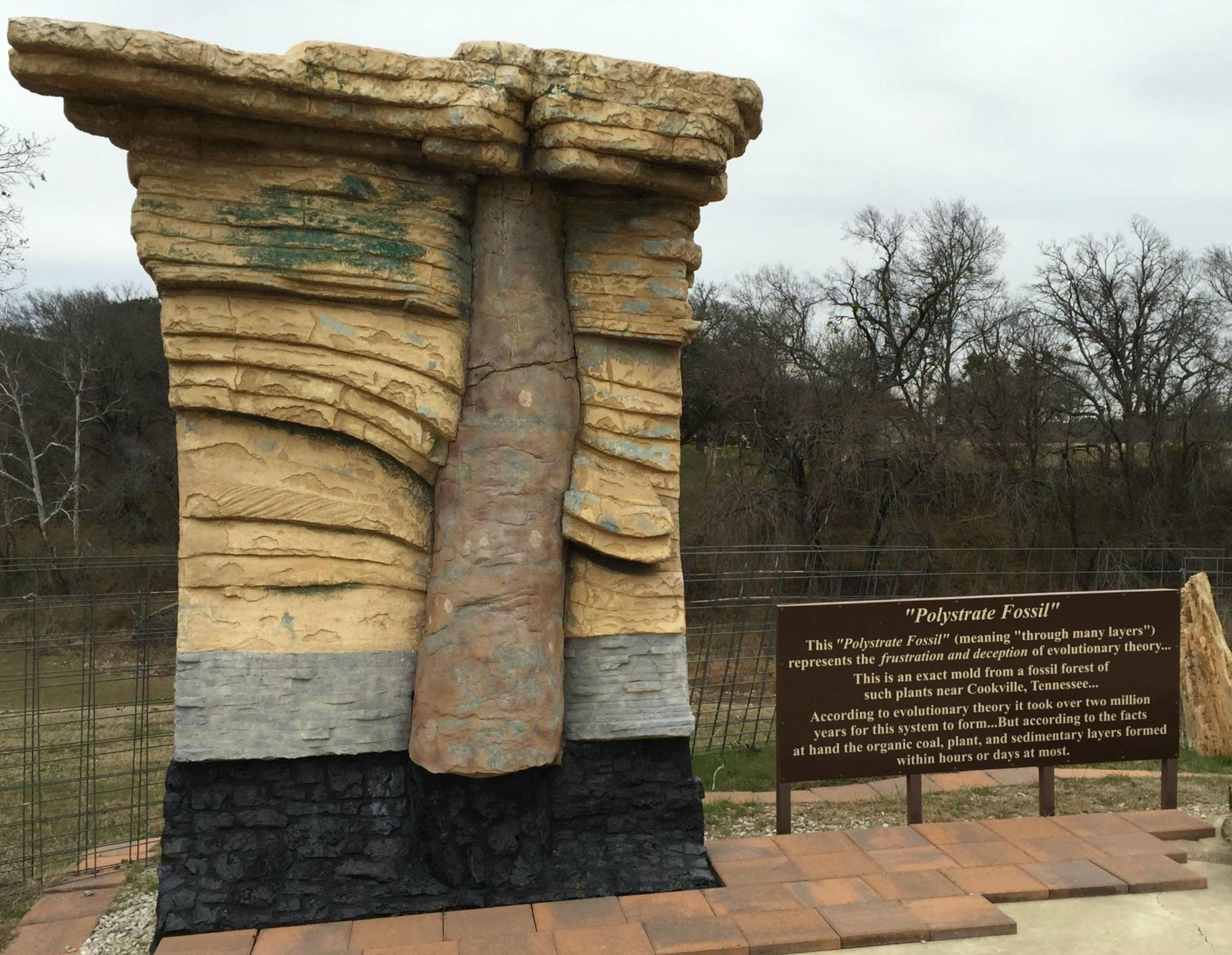
- There are polystrate fossils, trees, and in one case a whale, running straight up through many rock layers that are each said to represent ages. A tree cannot stand patiently for millions of years, upright, while one layer at a time settles over it. It rots and falls in a season. The layers must have been laid down quickly.
2) Carbon Dating
The second question is always carbon dating, so here is the answer:
Cosmic rays from the sun strike nitrogen in the atmosphere and produce a radioactive form of carbon, carbon-14. Plants take it in from the air, animals take it in by eating the plants, and as long as a thing is alive, it keeps topping up its supply. The moment it dies, the intake stops, and the carbon-14 it has begins to decay.
Now here is the part to hold onto: no scientist can actually measure the age of anything. What they measure is the amount of a chemical that is present, and then they make a set of assumptions to turn that into a date. Carbon-14 has a half-life of about 5,730 years, meaning half of it disappears in that time, regardless of how much there was to begin with. Do the maths. After about fifty thousand years there should be no detectable carbon-14 left at all:
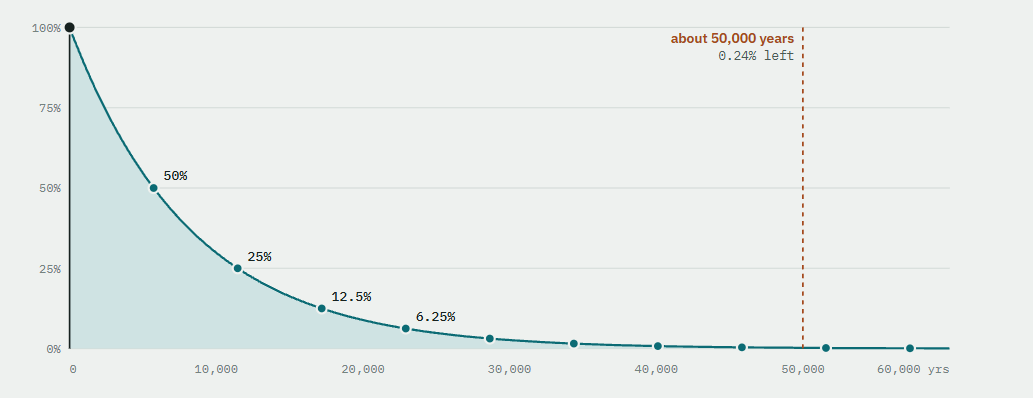
And yet coal, supposedly hundreds of millions of years old, consistently still contains carbon-14; to this day no source of coal has been found completely without it. On the long-ages theory, this is an unsolved mystery. On the Bible's account, where the first man and the animals appeared about six thousand years ago, it is exactly what we would expect to find.
Conclusion
So we come back to where we started, to a question of authority and of who was actually present. God put it to Job directly:
"Where were you when I laid the foundations of the earth?" (Job 38:4)
None of us were there. Not one scientist, not one skeptic, not one of us. Only One was, and He has told us plainly how it happened.
"For by Him were all things created, that are in heaven, and that are in earth." (Colossians 1:16)
Jesus Christ, the greatest teacher who ever lived, treated Genesis and the whole Bible as fact. So should we! And if we can trust Him about the earthly things, the things we can dig up and weigh and count, then we have every reason to trust Him about the heavenly things still to come.
So we will end here. This is Apologetics III, but it will really form the foundational teaching of our new series, A Guide Through the Old Testament, releasing next week!
Be blessed!