
Welcome back to another entry in our Eschatology Foundations series. So far we have given you a Revelation Starter Pack, unpacked the 7 Things That Must Happen Before Tribulation, and shown you the Chiastic Structure of Revelation. But there is one foundation we have not laid yet, and without it, the rest of end times prophecy is much harder to make sense of.
That foundation is Daniel & Ezekiel, both of which deal with the Prophetic.
If you want to understand Revelation, you have to understand Daniel. Revelation references the Old Testament over 800 times, and Daniel is one of the books it leans on most heavily. The visions John sees in Revelation, the beasts, the kingdoms, the timelines, almost all of it builds on top of what God already revealed to Daniel whilst in exile in Babylon, around 600 years before Christ.
In today's teaching, we will look at Daniel's statue vision. This vision really starts to put End Times into perspective, as it shows how God uses prophets to speak to the future.
Let's dive in. By the end, I think you will see why our generation has more reason to look up than any generation before us.
The Book of Daniel
The Book of Daniel contains many dreams and visions of strange things. It also reminds us of the hatred of the world towards the Jewish people. If you have not read our quick teaching on Where the Hate for the Jews Comes From, I would encourage you to read that for extra context. However, it is a member-only post and is not critical for this teaching.
The Book of Daniel is one of the most prophetically rich books in the entire Bible. It contains many dreams and visions of strange things: massive statues, four-headed beasts, rams clashing with goats, a "son of man" coming on the clouds, and timelines that stretch from Babylon all the way to the return of Jesus.
There is a reason Jesus Himself quoted Daniel when teaching about the end times in Matthew 24, and a reason Revelation borrows so heavily from him. If you understand Daniel, reading Revelation and other prophecies becomes much easier.
Intro Thoughts I - A Man We Should Strive to Be Like
But before we get into the visions, it is worth understanding the man and the moment.
Starting in Chapter 1, Daniel was a young Jewish man when Babylon invaded Judah around 605 BC. He was taken captive by Nebuchadnezzar's army, dragged hundreds of kilometres from his home in Jerusalem, and forced to serve in a pagan court that worshipped foreign gods. He even had a forced name change (from Daniel, meaning "God is my judge", to Belteshazzar, a name honouring a Babylonian deity). He was forced to eat food that went against his beliefs. He was surrounded by magicians, sorcerers, and astrologers. By every measure, his world had been destroyed.
And yet, Daniel never wavered. He ate Biblically, even when it could have cost him his life. He prayed three times a day with his window open toward Jerusalem, even when it landed him in a den of lions. He served his pagan kings faithfully, but he never bent the knee to their gods. This is the kind of man God entrusted with some of the most important prophecies in Scripture.
This is the kind of character God can use, and one we should strive to be like.
Daniel also stands out in this book as a man of commitment to God. He never plays the victim. Even though his home was destroyed, his temple was burned, and his entire religion was crippled, he never played the "How could you let this happen, God?" card. Instead, he tries to serve God in the best way he can.
This is a posture all of us as believers should learn from. Sometimes God allows bad things to happen, not because He has abandoned us, but because He is positioning us. Joseph went through slavery and prison before he ruled Egypt. Daniel went through exile before he stood in front of kings. Where you are right now might be your training ground for what God wants to do later.
It is very important how you respond in these seasons. Joseph had multiple setbacks in his journey, and only after God saw that Joseph had the correct response did He allow him to be promoted. It is entirely possible that you will stay stuck in a testing season if you do not respond properly.
Intro Thoughts II - Persecution of God's Chosen People
Which brings us to the second thing the Book of Daniel reminds us of: the hatred of the world toward the Jewish people.
Read Daniel carefully, and you see this pattern again and again. Nobles in the king's court conspire against Daniel for no reason other than that he is a Jew who serves the LORD (Daniel 6). His three friends, Hananiah, Mishael, and Azariah (renamed Shadrach, Meshach, and Abednego), are thrown into a furnace because they will not bow to a Babylonian idol (Daniel 3). The book of Esther, set during the same general period of exile, shows us Haman trying to wipe out the entire Jewish race in a single day.
This is not new. The hatred of God's chosen people stretches from Pharaoh to Haman, to Antiochus IV, to Hitler, to October 7th, 2023. And I expect this to continue rising.
It is the same spirit, it is the same enemy, and it has the same source. If you have not read our teaching on Where the Hate for the Jews Comes From, I would encourage you to check it out for extra context. It is members-only and is not critical for this teaching, but it puts a lot of what Daniel writes about into sharper focus.
Let's now dive into Daniel and start to unpack his very first prophetic interpretation - Nebuchadnezzar's Statue.
Daniel & Nebuchadnezzar's Introduction
Starting in Chapter 2, we get Nebuchadnezzar's dream. Nebuchadnezzar is the ruling king of Babylon, and the one who gave the order to invade Judah, destroy Jerusalem & take Daniel, Ezekiel, and all the other Jews into captivity. He is the most powerful man on Earth at this point in history, and his empire stretches from modern-day Iraq across the entire Middle East.
Let's continue the story in Daniel 2.
The Dream Nobody Could Interpret
At this point in the story, the King has a strange dream. Nebuchadnezzar is the ruling king of Babylon, and the one who gave the order to invade Judah, destroy Jerusalem & take Daniel, Ezekiel, and all the other Jews into captivity. He is the most powerful man on Earth at this point in history, and his empire stretches from modern-day Iraq across the entire Middle East.
This dream was so disturbing to him that he sought wise men throughout the land to interpret it. Read the verses below:
Dan 2:1 In the second year of his reign, Nebuchadnezzar had dreams; his mind was troubled and he could not sleep....
Dan 2:2 So the king summoned the magicians, enchanters, sorcerers and astrologers to tell him what he had dreamed. When they came in and stood before the king,
Now here is where the King makes things impossible. He refuses to tell his wise men what the dream actually was. He demands they tell him both the dream and the interpretation. If you have ever played 20 Questions, imagine doing that with no questions allowed and your life on the line.
Dan 2:11 "What the king asks is too difficult. No one can reveal it to the king except the gods, and they do not live among humans."
Dan 2:12 This made the king so angry and furious that he ordered the execution of all the wise men of Babylon.
Daniel was caught up in this execution order, even though he had nothing to do with the original meeting. So he goes to the king's officer to find out what is going on:
Dan 2:15 He asked the king's officer, "Why did the king issue such a harsh decree?" Arioch then explained the matter to Daniel.
Dan 2:16 At this, Daniel went in to the king and asked for time, so that he might interpret the dream for him.
I love the boldness Daniel showed. A young Jewish exile, who had not even seen the King, walks up to the most powerful man in the world and says: "Give me some time, and I will tell you what your dream meant."
Daniel then goes home, gathers his three friends (Hananiah, Mishael, and Azariah, better known as Shadrach, Meshach, and Abednego - Also, why does the Church call these 3 by their Babylonian Diety names instead of their Jewish names?), and they pray. God reveals the entire dream and its meaning to Daniel in a vision that night (Dan 2:19). Daniel praises God, and then walks back into the king's court the next morning with the answer.
You are now caught up on the story, and now the interesting parts begin from Verse 31
The Statue
Daniel begins to interpret Nebuchadnezzar's dream:
Dan 2:31 “Your Majesty looked, and there before you stood a large statue—an enormous, dazzling statue, awesome in appearance.
Dan 2:32 The head of the statue was made of pure gold, its chest and arms of silver, its belly and thighs of bronze,
Dan 2:33 its legs of iron, its feet partly of iron and partly of baked clay.
It is important to focus on verses 31 to 33, as this contains the prophetic information. The statue had:
- Head made of Gold
- Chest and Two Arms made of Silver
- Belly and Thighs made of Bronze
- Two Legs made of Iron
- Feet made of Iron and Clay
I tried asking AI to make something, and while I am not blown away by it, it illustrates it fine. (The Feet are missing the clay part, though!)
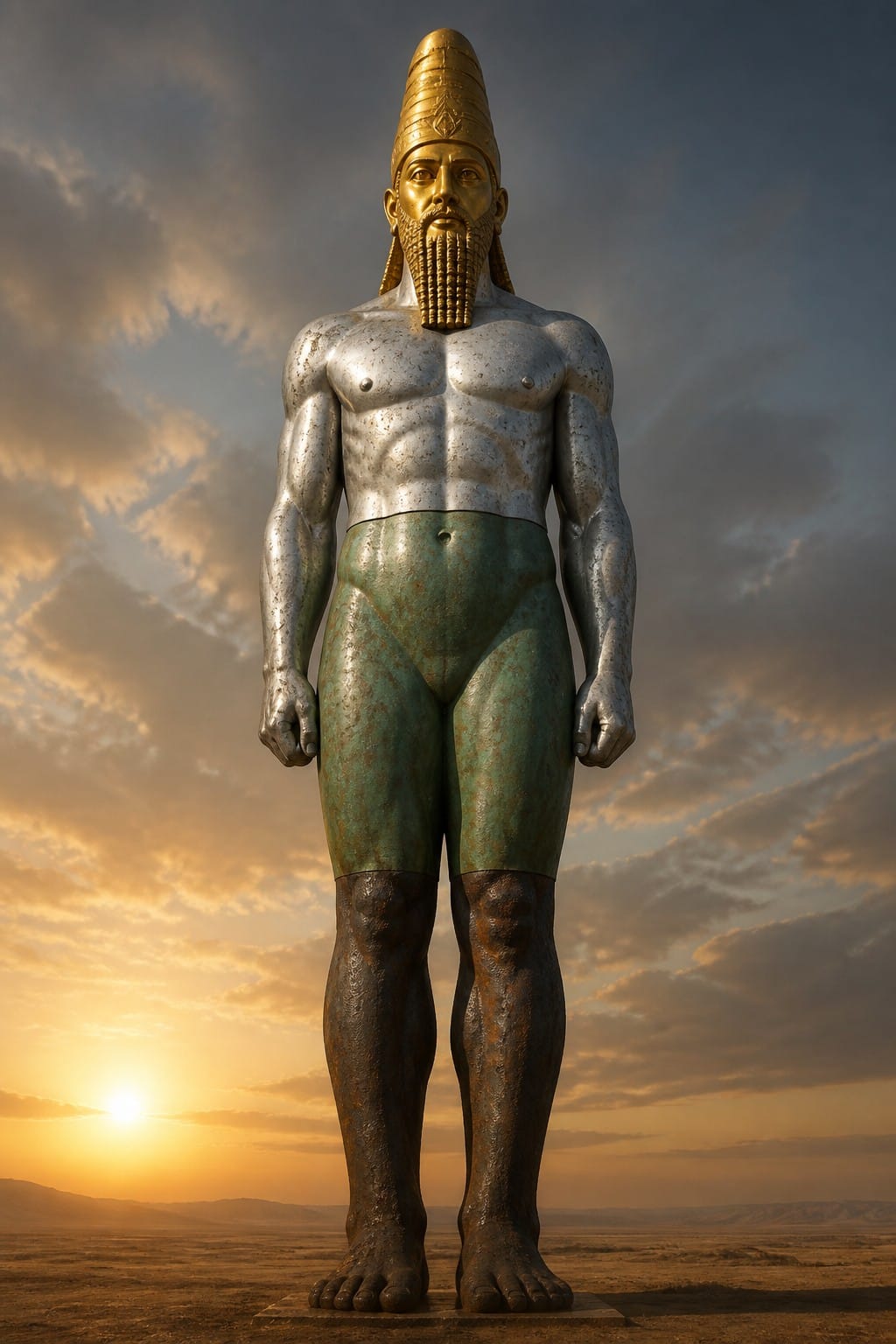
Now remember, Daniel describes this entire statue to the King without the King ever having told anyone what the dream was!
He starts revealing the meaning, and let's walk through them one by one.
The Head of Gold: The Babylonian Empire
Dan 2:37 Your Majesty, you are the king of kings. The God of heaven has given you dominion and power and might and glory;
Dan 2:38 in your hands he has placed all mankind and the beasts of the field and the birds in the sky. Wherever they live, he has made you ruler over them all. You are that head of gold.
Daniel reveals immediately that Nebuchadnezzar's Kingdom is the head of gold, making Babylon the first kingdom in this vision. It is made of gold, showing it was the most glorious, the wealthiest, the most magnificent.
And historically, this was true. Babylon under Nebuchadnezzar was the greatest city in the world at the time. The Hanging Gardens of Babylon were considered a wonder of the Ancient World. The city walls were so wide that chariots could race on top of them. It was a marvel of engineering, art, and culture.
There is also something interesting here. Each kingdom in this prophecy is described as worth less than the one before it. Gold gives way to silver. Silver to bronze. Bronze to iron. Iron mixed with clay. Human history is on a downward trajectory in terms of glory and unity, even as it advances in technology and knowledge. That should make you think.
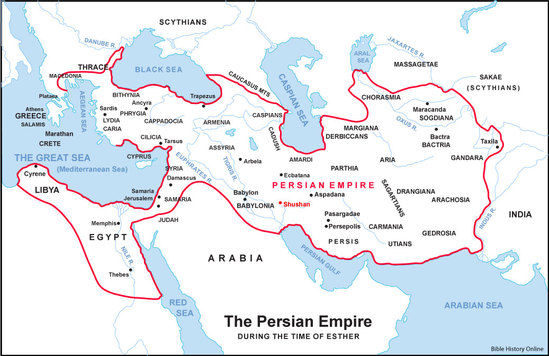
The Chest and Arms of Silver: The Medo-Persian Empire
Dan 2:39 After you, another kingdom will arise, inferior to yours
This is where things get really awesome. Daniel says the kingdom after Babylon will be lesser (silver instead of gold) and is represented by a duality (two arms, one chest).
If we look back at history, what kingdom came after Babylon? The Medo-Persian Empire. This was a dual kingdom made up of the Medes and the Persians. Two distinct peoples, joined together as one empire. Two arms, one chest. How awesome is the Bible!
The Medes and Persians conquered Babylon in 539 BC under Cyrus the Great. If you read Daniel 5, you actually see this happen in real time. Belshazzar (Nebuchadnezzar's grandson) is throwing a wild party using the sacred vessels stolen from the Jerusalem Temple, and a hand appears out of nowhere and writes on the wall: "Mene, Mene, Tekel, Parsin." Daniel is called in to interpret it, and he tells Belshazzar that his kingdom has been "weighed in the scales and found wanting" (Dan 5:27). That very night, Babylon falls to the Medes and Persians. We will look at this in the next teaching.
How awesome it is that Daniel was alive to see his own prophecy fulfilled? He told Nebuchadnezzar about the silver kingdom decades earlier, and then watched it happen with his own eyes.
Why was Medo-Persia "inferior" to Babylon? Its size. The Persian Empire was actually larger than Babylon's. But Babylon was a single, unified kingdom under one absolute ruler. Medo-Persia had to balance two cultures, two royal houses, and a more decentralised system. Less glorious, but still massive.
A small bit of trivia - As we mentioned, this Kingdom was ruled by Cyrus the Great, the king God prophesied by name 150 years before he was born (Isaiah 44:28-45:1). Cyrus is the one who issued the decree allowing the Jews to return to Jerusalem and rebuild the temple (Ezra 1).
The Belly and Thighs of Bronze: The Greek Empire
Dan 2:39 Next, a third kingdom, one of bronze, will rule over the whole earth.
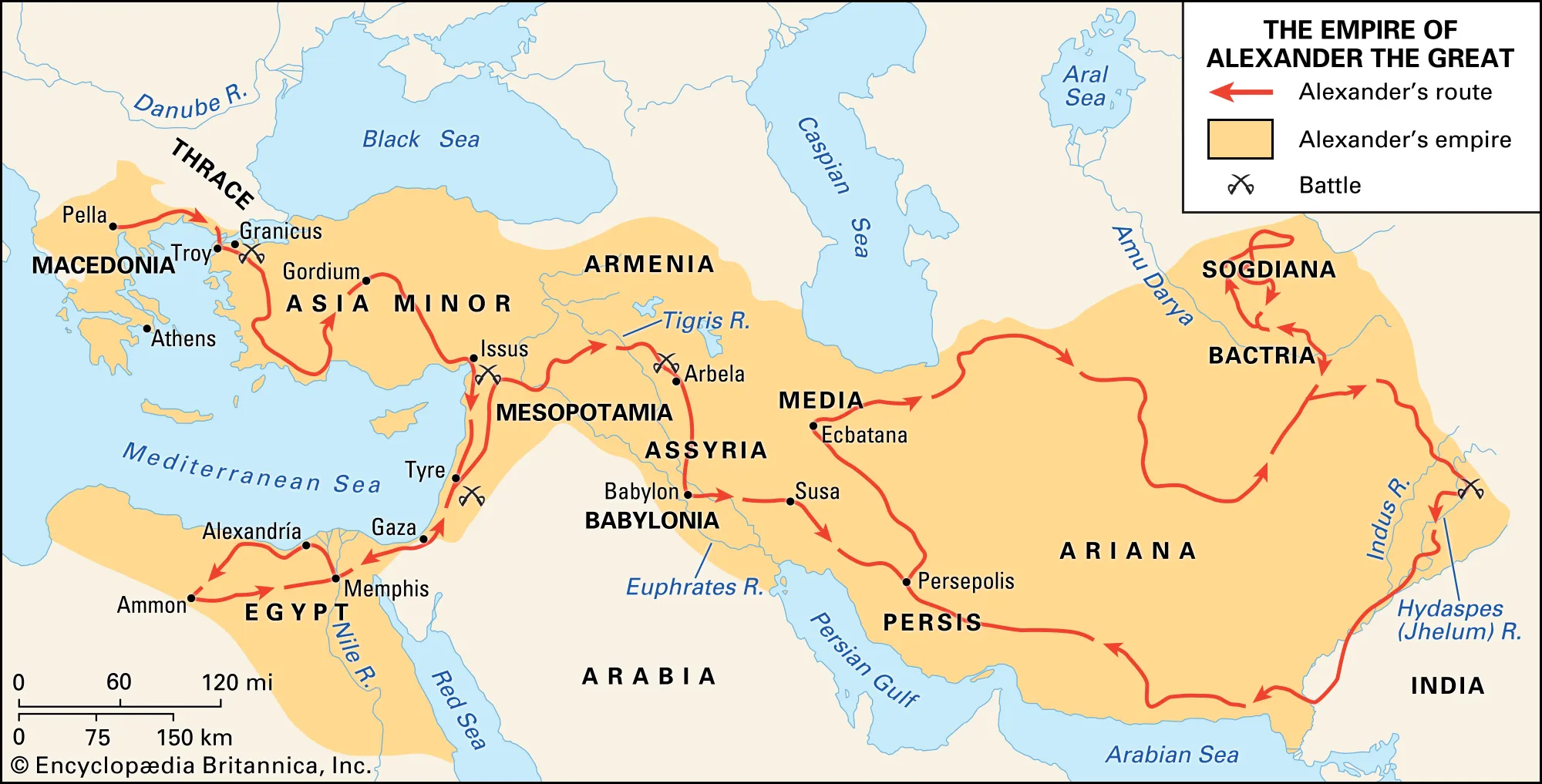
Once again, Daniel continues to prophecy the future. It is a lesser kingdom (bronze, not silver), but notice what God adds this time: it will rule over the whole earth.
The next kingdom after Medo-Persia was the Greek Empire under Alexander the Great. And this is not the Greece you think about today. Alexander's empire was massive. He conquered the entire known world from Greece, through Egypt, across the Middle East, and all the way to India by the time he was 32 years old. He never lost a battle.
Why bronze? Because the Greek soldiers were famous for their bronze armour, helmets, and shields. The classical hoplite (Greek foot soldier) is the most recognisable image of bronze warfare in human history. God's symbolism is never accidental!
Why the belly and two thighs? Because after Alexander died suddenly at age 32 (likely poisoned), his empire was divided among his four generals, but eventually consolidated into two main dynasties: the Seleucids in the East and the Ptolemies in Egypt. Daniel actually expands on this in chapter 8, where he describes a goat with one prominent horn (Alexander) that gets broken off and replaced by four horns (his four generals). God is an amazing author. We will dive into this in a later teaching.
The Two Legs of Iron: The Roman Empire
Dan 2:40 Finally, there will be a fourth kingdom, strong as iron—for iron breaks and smashes everything—and as iron breaks things to pieces, so it will crush and break all the others.
After Greece, we had the Roman Empire. The one who crucified Yeshua and ruled with an iron fist. They were not the most glorious empire, but they were the strongest and most ruthless. Said exactly according to the scripture above.
"Strong as iron... it will crush and break all the others." That is exactly what Rome did. They built roads, aqueducts, and legal systems that lasted 2,000 years, but they also built crosses and arenas where they fed Christians to lions for sport.
Now, why two legs? Again, God was telling the future through Daniel. And because we live 4000 years on, we have the privilege of looking back and seeing these Kingdoms having already manifested. In 285 AD, Emperor Diocletian split the Roman Empire into Eastern and Western halves. By 395 AD, this division became permanent: the Western Roman Empire (centred in Rome) and the Eastern Byzantine Empire (centred in Constantinople, modern-day Istanbul). The Western Empire fell in 476 AD. The Eastern Empire lasted all the way until 1453 AD when Constantinople fell to the Ottomans.
The Two Feet of Iron and Clay: Our Current Age
Before we get into this breakdown, I want to flag something. These verses are really cool. What they tell us is that we are the last kingdom before Jesus returns.
Scripture - Dan 2:41 Just as you saw that the feet and toes were partly of baked clay and partly of iron, so this will be a divided kingdom; yet it will have some of the strength of iron in it, even as you saw iron mixed with clay.
Dan 2:42 As the toes were partly iron and partly clay, so this kingdom will be partly strong and partly brittle.
Dan 2:43 And just as you saw the iron mixed with baked clay, so the people will be a mixture and will not remain united, any more than iron mixes with clay.
Dan 2:44 “In the time of those kings, the God of heaven will set up a kingdom that will never be destroyed, nor will it be left to another people. It will crush all those kingdoms and bring them to an end, but it will itself endure forever.
This is confirmed in verse 44: "In the time of those kings, the God of heaven will set up a kingdom..." Notice the timing: in the time of those kings. Not after some other empire rises. Not after China takes over. Not after Russia conquers Europe. In the time of the iron-and-clay.
So what is happening in this kingdom?
It still has iron in it, so it has Roman DNA. But it has clay mixed in. Iron and clay do not mix well, and Scripture explicitly tells us this kingdom "will not remain united." Most theologians agree that this is what is called the Revived Roman Empire, and this is what we are living in today.
Think about it. After the Western Roman Empire fell, who conquered the world? Europe. France, Spain, Germany, England, Portugal, the Netherlands. Every one of them is built on Roman foundations. They use Roman legal systems, Roman alphabet, Roman architecture, Roman roads, and even Roman religion (Catholicism is literally headquartered in Rome).
And then America was founded by Europeans. The U.S. Capitol building is modelled after Roman architecture. The Senate is named after the Roman Senate. America is, in many ways, an extension of the Roman world.
Most of the known world today has been shaped by the Roman Empire and its descendants. And since Europe (the EU) and America (an extension of Europe) are ruling now, it appears that this current age ruled by the West is the final Kingdom that Daniel spoke about. So when people bring up fears about us being taken over by China or Russia, don't be worried. God told us 1000's of years ago how the story ends!
The Bible makes it clear: when the Revived Roman Empire is ruling, you are near the end. This is what makes our time on Earth so exciting!
So why iron and clay? Iron is the Roman strength still present in our institutions, militaries, and laws. Clay is the brittleness, the division. I think this is quite evident to see in today's world. Look at the EU trying (and failing) to hold together. Look at Brexit. Look at America's internal divisions.
There is another angle, which I also believe is true, and that is the mixing of Christianity and Islam through sketchy immigration methods. Iron could represent the Christian origins, and Clay represents those of Islam. The two are not compatible and are creating even more division.
The Rock that Destroys the Statue
Earlier on when Daniel was describing the dream, he mentioned what happens after the Kingdoms are finished:
Dan 2:34 While you were watching, a rock was cut out, but not by human hands. It struck the statue on its feet of iron and clay and smashed them.
Dan 2:35 Then the iron, the clay, the bronze, the silver and the gold were all broken to pieces and became like chaff on a threshing floor in the summer. The wind swept them away without leaving a trace. But the rock that struck the statue became a huge mountain and filled the whole earth.
Remember earlier, when we taught on the Mountain of Edom/Seir and the Mountain of Israel? In biblical language, a mountain represents a kingdom. When God talks about Mount Zion, He is not just talking about a hill in Jerusalem. He is talking about His Kingdom. When Ezekiel prophesies against Mount Seir, he is talking about Edom's whole nation.
So watch what God is saying here. A rock, cut without human hands, strikes the final kingdom and destroys it. Then that rock becomes a mountain that fills the whole Earth.
That rock is Jesus. Daniel is telling us:
- Jesus will personally destroy the final earthly kingdom (no global warming, no human revolution, no political solution. He will do it Himself).
- The destruction will be total. Not just the iron-and-clay kingdom, but all the previous kingdoms get crushed to dust along with it. Every empire that ever stood against God's people gets erased in one moment.
- After the destruction, Yeshua's Kingdom will fill the whole Earth and never end.
Amazing! And to think we are closer than ever to this moment.
Conclusion
Let's take a step back and appreciate what God has just shown us through Daniel.
A young Hebrew exile, taken as a captive, standing in a foreign king's court, accurately predicts the next 2,500 years of human history. Not vaguely, but specifically. Four successive empires, in the right order, with the right characteristics, ending with a divided kingdom of iron mixed with clay.
- Babylon fell to Medo-Persia in 539 BC.
- Medo-Persia fell to Greece under Alexander the Great in 331 BC.
- Greece fell to Rome by 146 BC.
- Rome split in two in 395 AD and eventually fragmented into the modern Western world we are living in today.
Daniel got it right four times in a row. When God says something will happen, it happens. Every single time.
So here is the question worth sitting with: if Daniel was right about Babylon, right about Medo-Persia, right about Greece, right about Rome, and right about the Revived Roman Empire we are living in now, is there any reason to doubt the ending? The Rock cut without human hands is still coming. Yeshua is still coming. And when He strikes the statue, He will not be establishing a sixth earthly kingdom. He will be establishing the Kingdom.
Daniel 2 is a foundation stone for everything else in end-times prophecy. The four kingdoms in Daniel 2 show up again in Daniel 7 as four beasts. The fourth beast and its iron-and-clay nature shows up again in Revelation 13 as the beast from the sea. The Rock that becomes a mountain shows up again in Revelation 11:15. It is one story, told by an amazing God.
Our job in the meantime is what Daniel's job was: serve God faithfully where He has placed us, do not play the victim, and keep our eyes open. The Bible has told us where we are on the timeline. The next move is the LORD's.
Be Blessed!